A need for a new production process | Chapter 2: The Opportunity
The chlor-alkali process produces caustic soda (NaOH), a chemical critical for
- pharmaceuticals
- alumina refining
- wastewater treatment
- desalination
- paper & soap
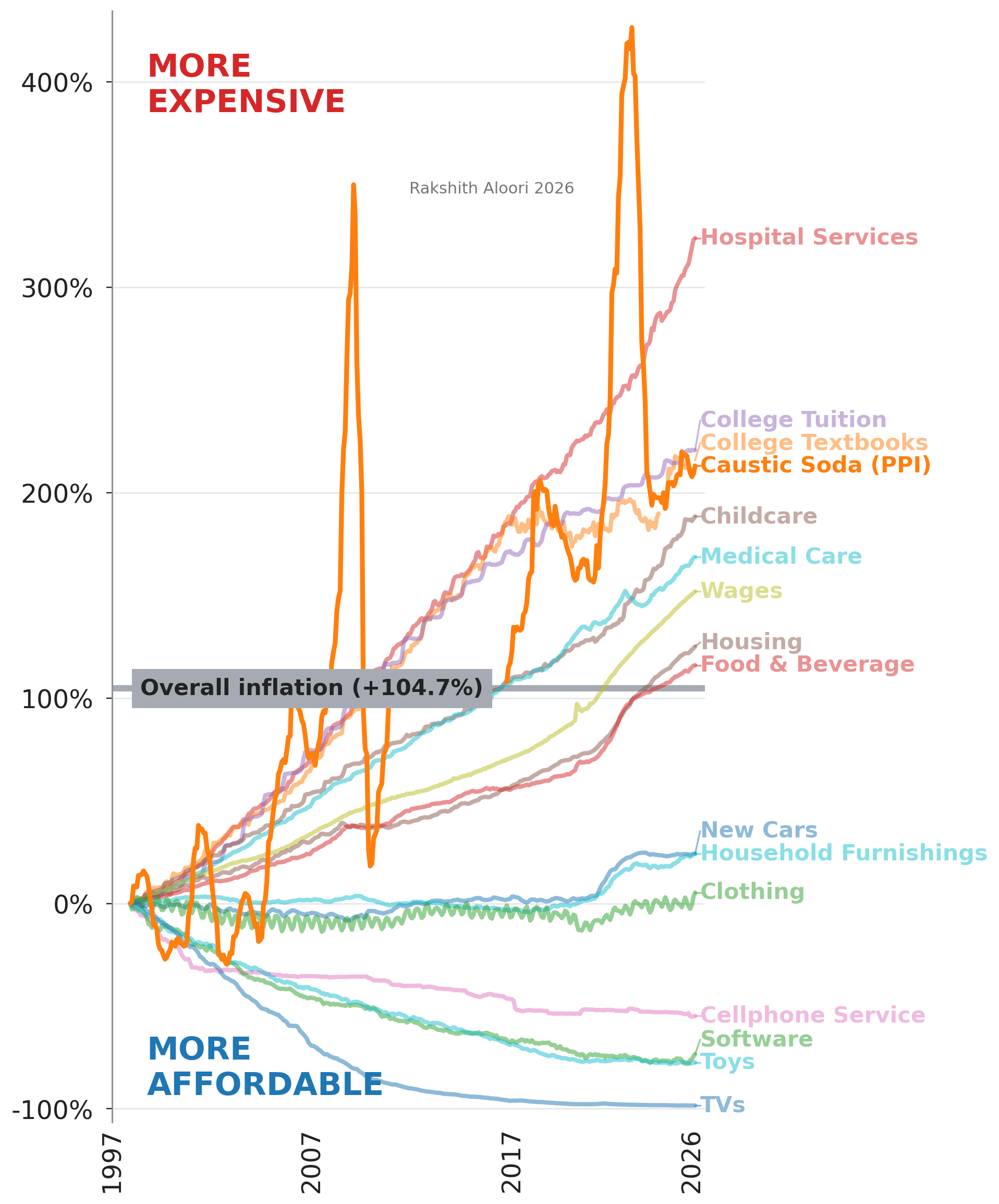
Caustic soda, despite being a simple chemical, has grown more expensive faster than Medical Care (!!)
I charted it against other things from Patrick Collison's "Why are certain things getting so much more expensive?"
This has to seem strange. Why does the cost keep going up faster? For a commodity, that's absurd.
Here, I dig into why the chlor-alkali industry isn’t switching to solar and why we, at Hydropunk, are building a new industrial production process for caustic soda.
Electricity is by far the biggest input cost in the chlor-alkali process. When you buy caustic soda, you are buying ~2,500 kWh/dry-ton of electricity. At a market price of $400/dry-ton, >50% of the production cost is just electricity.
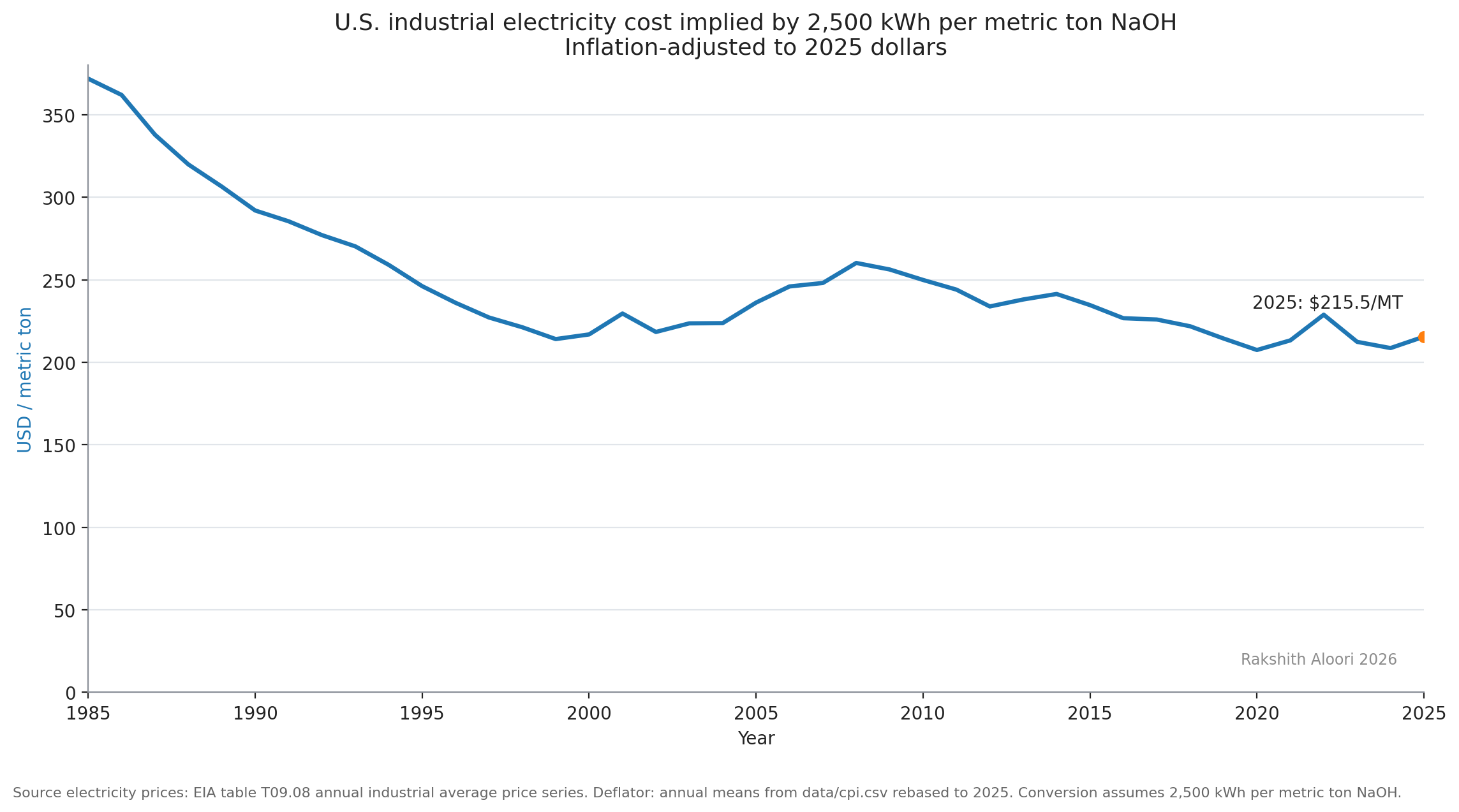
The (inflation-adjusted) cost of 2,500 kWh of electricity in the US stayed steady over the decades at ~$210/dry-ton. So, electricity isn't the reason the cost is going up. And also, why don’t chlor-alkali operators switch to solar?
Even though electricity is the biggest OPEX of the chlor-alkali process, almost no plant operator I talked to is optimising for solar because:
- Solar's intermittency is terrible for the membranes and causes mechanical fatigue.
- For the current chlor-alkali CAPEX, batteries + solar is cheaper than battery-free solar.
Why is solar’s intermittency terrible for the membranes?
Membranes swell during operations. When halted, they deswell. Following solar’s diurnal cycles means swell/deswell cycles, which create microcracks compromising the longevity of the membranes. These membranes are expensive. A single tear causes the electrolyser's efficiency to take a hit and the production process halts. Chlor-alkali producers can’t afford that. So, you supplement solar with batteries or the grid to run 24-hour operations and keep the membranes in a swollen state.
Despite solar and batteries getting cheaper, the existing chlor-alkali industry is yet to switch away from the grid. No plant operator I talked to in India, the UAE or Malaysia is switching to solar.
But the MORE interesting reason they can’t use battery-free solar is structural.
Say you have an MW load. How much solar (+ batteries) do you need to achieve the lowest total CAPEX/utilisation that produces the cheapest product?
Casey Handmer performed an analysis and observed two stable attractors.
- <$1000/kW loads are cheapest with oversized solar. No batteries.
- >$2000/kW loads are cheapest with oversized solar + batteries. Not battery-free solar.
Why optimise for total CAPEX/utilisation? Because you want to spend as little money as possible to perform (or utilise) a process. Optimising for total CAPEX/utilisation is the key insight in solar+batteries play.
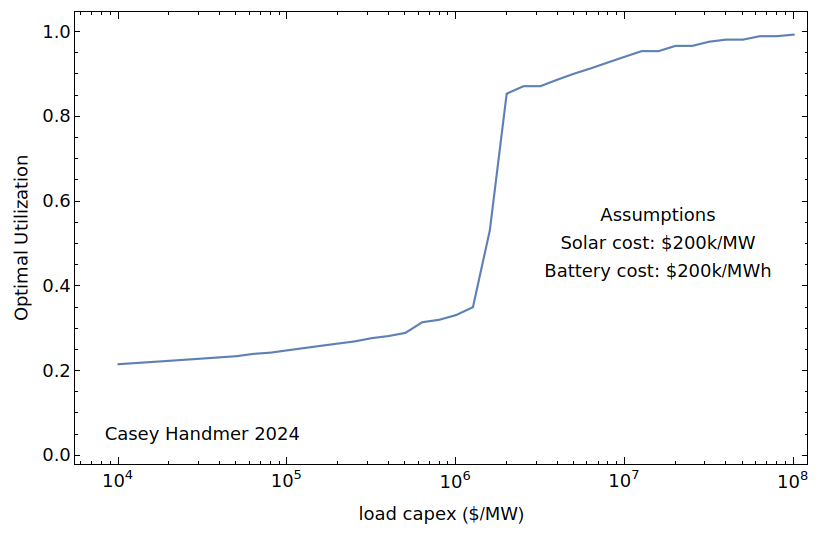
If your load CAPEX is >$2000/kW, you are losing money by not operating it beyond solar’s diurnal cycle. But if it is <$1000/kW, your power system doesn’t need batteries, and you unlock a magnitude (10x) lower power system CAPEX costs. To protect against further solar price reductions, aim for $500/kW or lower CAPEX.
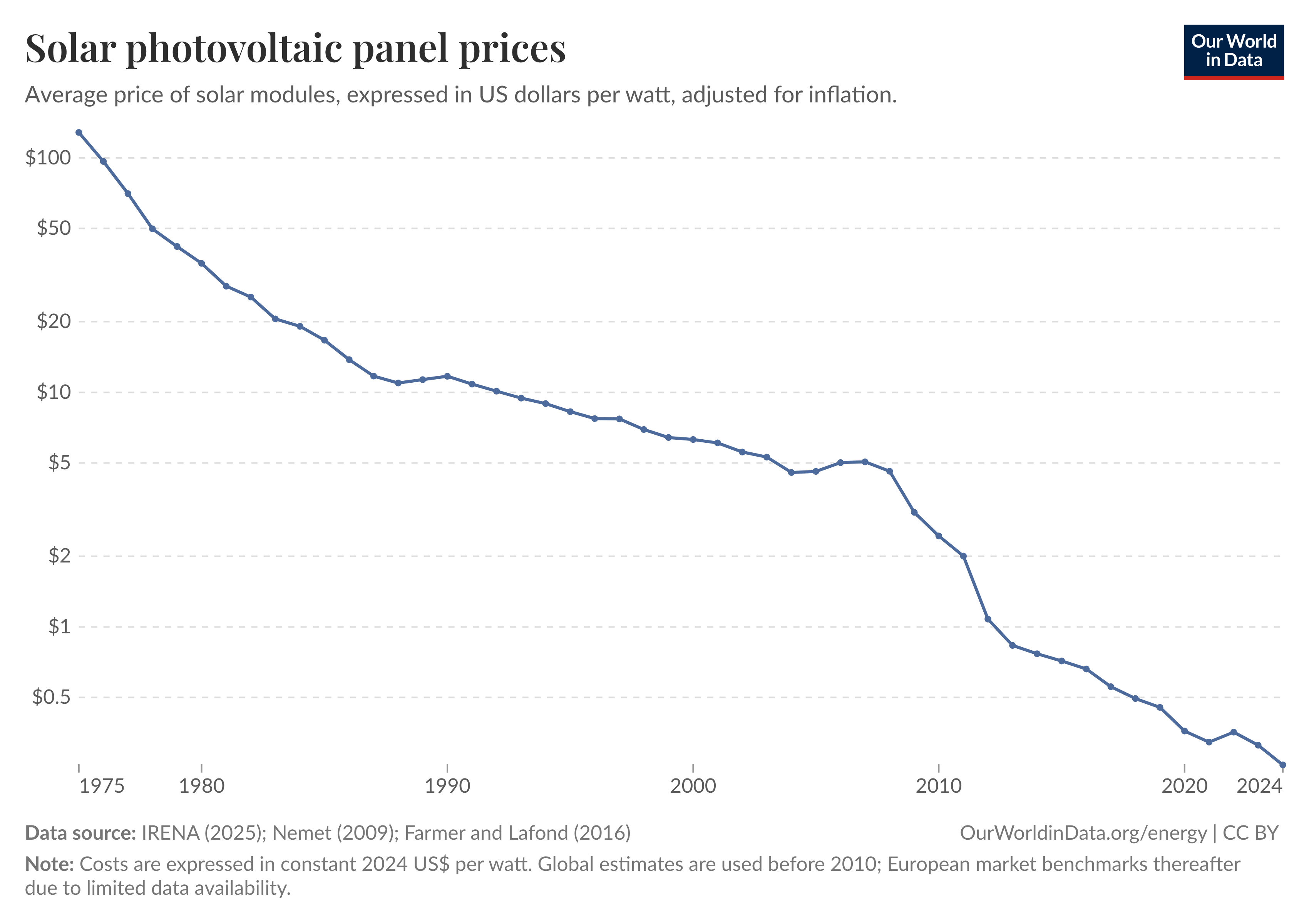
With 2025 solar prices, the pure solar threshold drops to <$400/kW from <$1000/kW.
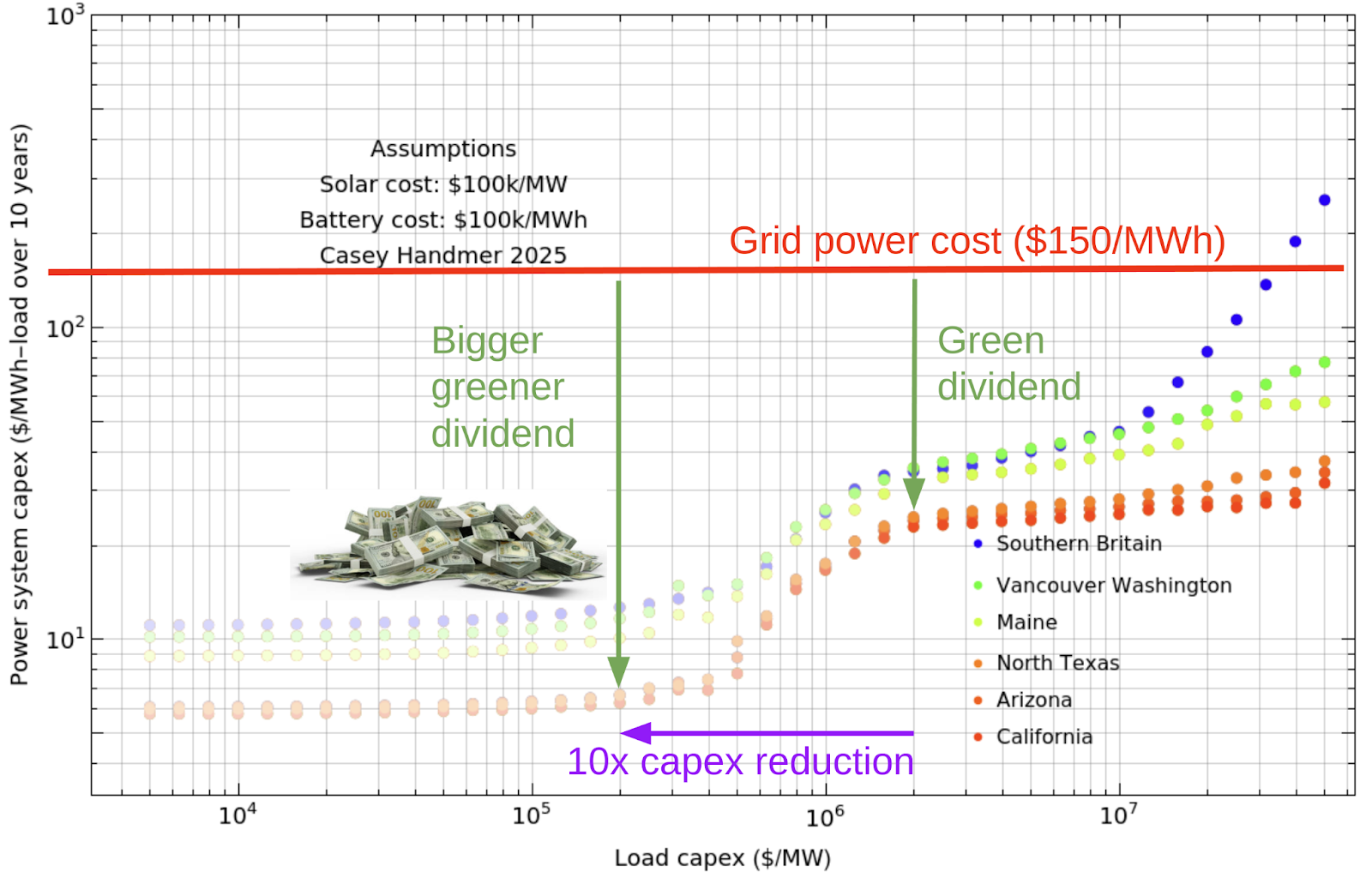
Chlor-alkali load CAPEX today is $1100-$2300/kW and $3700-$6300, putting it in the solar + batteries space, at 10x the power CAPEX compared to a <$400/kW process. How can we tap into cheaper power system CAPEX for chlor-alkali? Getting to <$400/kW requires re-thinking the entire chlor-alkali process, not just swapping a few parts for cheaper ones. In chlor-alkali, chlorine is the primary product, not caustic soda. What would it look like if we optimised a production process around caustic soda rather than chlorine?
At a market price of $400/dry-ton, you are paying $210/dry-ton just for electricity. It is worth a lot if we can transition to a cheaper electricity source like solar and cut the production cost of caustic soda.
Economically, what would have to be true for this new process to work? It comes down to the two variables.
- $/kWh-electricity: The cost of electricity
- $/kW-load: The cost of the plant
Assuming we hit a plant lifetime of 35,000 hours (4 years), efficiency of 0.4 kg-NaOH/kWh (2.5 MWh/ton-NaOH), and a market price of $400/ton-NaOH, we determine the winning (profit) and losing (loss) conditions of a new process against chlor-alkali.
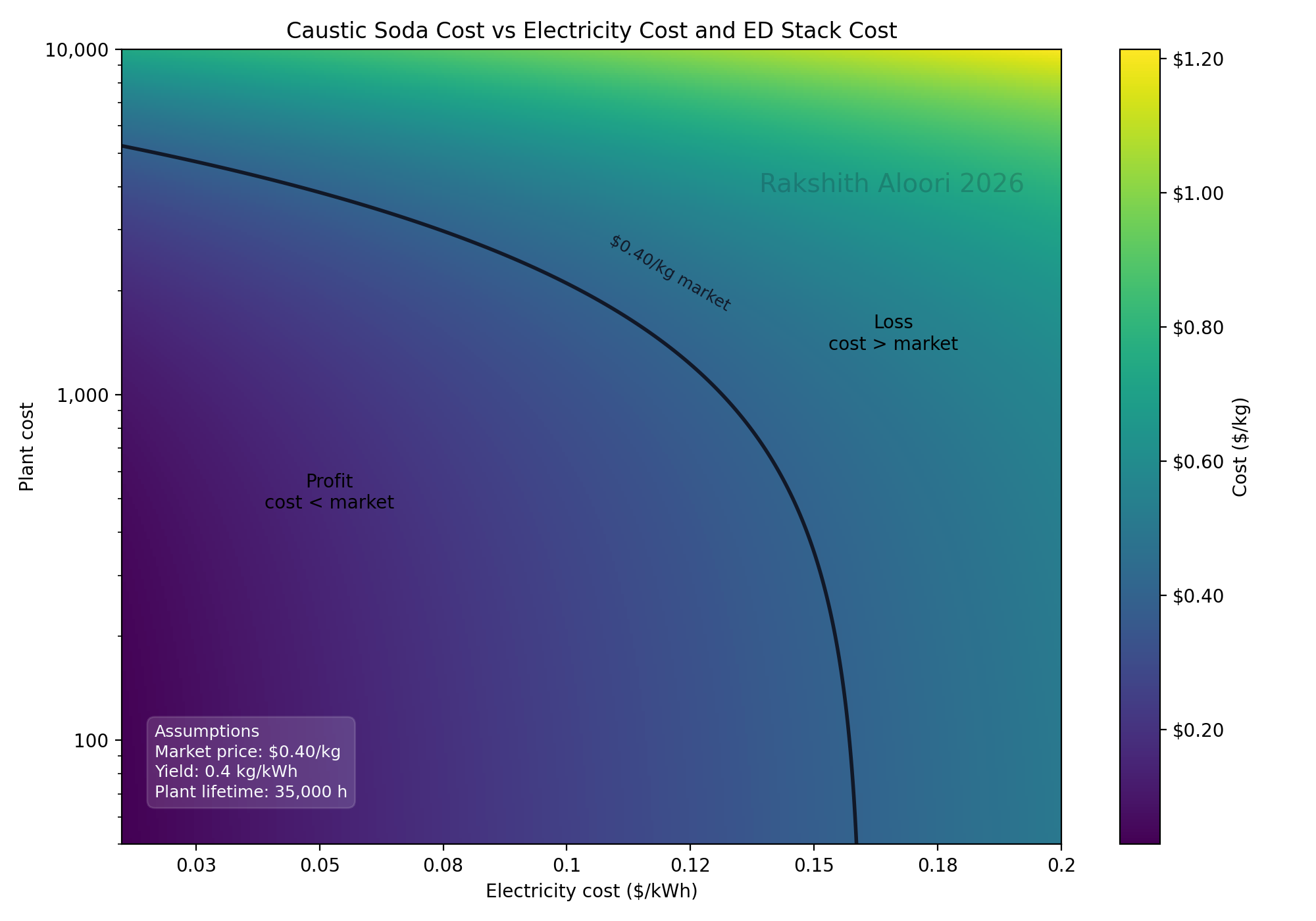
From the unit economics phase diagram, a new process has a big enough profitable design space ranging from ~$4000/kW at $0.03/kWh to ~$400/kW at $0.15/kWh.
An estimated 50-60% of global caustic soda production comes from operators who buy equipment and technology from the largest players. These largest players have in-house R&D teams; the others don’t. Meaning, most of the market (50-60%) isn’t ready for a fundamental technological change. The industry is fragmented. If a new process is structurally and economically efficient, it will out-compete these fragmented players.
The largest players, like Olin, are optimising for value over volume. This mantra was a response to the demand crash during COVID, but it has continued to this day, not simply as a COVID-only emergency tactic. This is (partly) why caustic soda prices keep going up. The market lacks competitive pressure to drive costs downwards.
Getting to <$400/kW will unlock structural cost advantages that chlor-alkali doesn’t have today. In a commodity business, this is how new companies survive and thrive. At Hydropunk Industries, we are building a caustic soda production process for <$400/kW and optimising for solar. How we do it is in part 3.